

Contents
MICE stands for Meetings, Incentives, Conferences and Exhibitions, with the C often read as conventions and the E as events. The term describes the business events segment of the travel and hospitality market, in which companies, associations and public institutions book and pay for gatherings with a professional purpose. For hotels and venues, MICE is the name for the group business behind meeting rooms, event spaces, conference packages and room blocks.
This guide looks at MICE from the perspective of a hotel or venue. It explains the four formats, how MICE differs from leisure and individual business travel, how large the market is in Germany and worldwide, what defines a conference hotel and which challenges the segment brings for a property. If you are interested in why MICE matters for companies and their event procurement, our guide to MICE from the corporate perspective covers that side.
The diagram shows how the parts of the MICE market fit together, from the organisations that book events to the venues that host them.
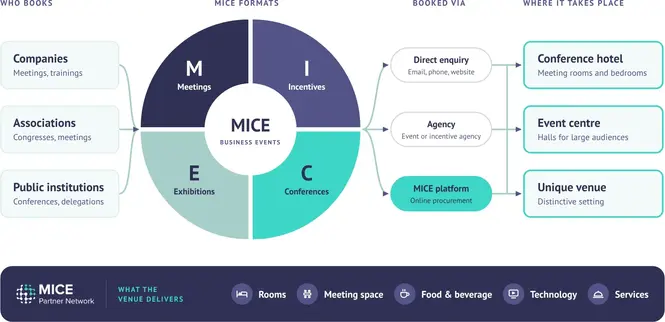
How MICE business reaches a venue, from the organisation that books to the services it delivers.
What does MICE stand for?
MICE is an acronym for Meetings, Incentives, Conferences and Exhibitions. In practice, two letters have more than one reading. The C stands for conferences or conventions, and the E stands for exhibitions or events. Both versions describe the same market, and both are in common use across the industry, in tourism statistics and among hotel sales teams.
Alongside MICE, the industry also uses the terms business events and meetings industry. The Events Industry Council, which publishes the most widely cited global study on the sector, works with the term business events and defines them as gatherings of 10 or more participants for a minimum of four hours in a contracted venue. Social, formal educational and recreational activities fall outside this definition. A wedding or a concert in your ballroom is therefore an event, but it is not MICE business.
What unites all MICE formats is the reason people come together. Participants travel because their employer, their association or a client sends them, and the organisation behind the event pays. This distinguishes MICE from every other type of demand a hotel sells to.
What are the four MICE formats?
The four MICE formats are meetings, incentives, conferences and exhibitions. Each one is bought for a different purpose and places different demands on a hotel or venue.
Meetings
Meetings are gatherings of a small to medium-sized group for a working purpose, such as a board meeting, a team workshop, a training session or a seminar. Day meetings are common, but a very typical format runs over two days, with arrival and a shared dinner on the first evening, one overnight stay and the meeting itself on the following day. Meetings usually come with a meeting room, technology and catering, and they are often booked at short notice. For many conference hotels, meetings are the format that arrives most often. On the MICE Portal platform, 54 percent of the enquiries in 2025 were for meetings with up to 20 participants.
Incentives
Incentives are trips or events a company uses to reward employees, sales partners or customers. The experience is the product, so location, atmosphere, activities and service quality weigh more heavily than meeting technology. Incentives usually include overnight stays and often a programme beyond the property itself.
Conferences and conventions
Conferences and conventions bring a larger audience together to share knowledge, usually over several days. They need a plenary room for the whole group, breakout rooms for parallel sessions, reliable technology, catering for many people at the same time and a substantial room block. Association congresses belong to this category as well as large internal company conferences.
Exhibitions and events
Exhibitions are trade fairs, product presentations and showcases in which companies present products and meet customers. They mostly take place in exhibition halls and congress centres. Hotels benefit primarily through accommodation for exhibitors and visitors, and through side events such as receptions or customer dinners. In the broader reading of the E, corporate events such as product launches, anniversaries or kick-off events also fall into this category.
The table compares the four formats by what the company is buying and what a property needs to provide.
In practice the labels blur. A quarterly review and a sales training are both meetings, a dealer trip and a long-service celebration are both incentives, and a scientific symposium and an annual general meeting both sit under conferences. A three-day congress often carries an incentive evening, and a trade fair appearance is usually preceded by an internal meeting in a hotel nearby.
What decides whether an enquiry fits your property is the right-hand side of the table rather than the label at the front.
How is MICE different from leisure travel and business travel?
MICE differs from leisure travel and individual business travel in who books, who pays and what the hotel sells. A leisure guest books a room for private reasons and pays personally. An business traveller books a room for a work trip, usually within a company travel policy. A MICE booking is placed by the company, association or institution hosting the event and combines rooms with meeting space, catering, technology and service for a group.
For a hotel, this difference shapes the entire sales process. Leisure and business stays arrive through booking channels as room nights. MICE business arrives as an enquiry that has to be qualified, priced and answered with an individual offer.
Why is MICE economically relevant?
MICE is economically relevant because business events form a global industry worth more than a trillion US dollars in direct spending. According to the 2026 Global Economic Significance of Business Events study by the Events Industry Council and Oxford Economics, 1.65 billion people took part in business events across more than 180 countries in 2025. Direct spending reached 1.3 trillion US dollars, 12.2 percent more than in 2019. The sector supported 1.8 trillion US dollars of global GDP and 24.2 million jobs, 9.7 million of them directly.
Western Europe accounts for 328 billion US dollars of direct spending, according to the Events Industry Council, behind North America and Asia. The study expects global direct spending on business events to grow to 1.6 trillion US dollars by 2028.
How big is the MICE market in Europe?
Europe is one of the three largest regions for business events worldwide. The figures in this section come from the Events Industry Council, the International Congress and Convention Association (ICCA), the global exhibition industry association UFI, the EU statistics office Eurostat and the Meeting & EventBarometer for Germany.
According to the Events Industry Council, direct spending on business events in Western Europe reached 328 billion US dollars in 2025, behind North America and Asia. Europe also leads in international association meetings. ICCA counted 12,438 such meetings worldwide in 2025, and Europe holds the largest share of them. Italy, Germany, Spain, the United Kingdom, France, Portugal and the Netherlands are all among the ten leading countries, and Lisbon, Paris, Barcelona, Vienna, Prague, Copenhagen and London are among the ten leading cities.
Exhibitions add a further layer to the market. In its Euro Fair Statistics, UFI recorded 2,240 audited exhibitions in 16 European countries in 2024, with 594,444 exhibiting companies, 53.8 million registered visits and 23.1 million square metres of rented space.
Business travel shows how much professional demand moves across the continent. According to Eurostat, EU residents made more than 123 million trips for professional purposes in 2024, 11.6 percent more than in the previous year. These trips accounted for 10.3 percent of all tourism trips, and 75.6 percent of them lasted three nights or fewer. The figure covers all business trips, including those to meetings and events.
Germany shows the scale of the market at country level. According to the Meeting & EventBarometer 2025/2026, the country hosted 2.02 million in-person events with 395.1 million participants in 2025. An event lasted 1.7 days on average, and congresses, conferences and seminars made up 54.1 percent of all events.
Why does MICE matter for my hotel's revenue?
MICE matters for a hotel's revenue because a single booking touches almost every revenue line of the property. A two-day conference can include a room block, meeting room hire, a conference package per participant, coffee breaks, lunches, a dinner, technology and additional services such as parking or an evening programme. Few other types of business combine this many revenue streams in one transaction.
Beyond revenue, MICE also helps a property plan. Group bookings are confirmed ahead of the event, which gives revenue management and operations a clearer picture of upcoming demand. Corporate meetings are scheduled within the working week, which means they fill different days than leisure demand. For many conference hotels, this is why the MICE segment carries a large part of the business.
Photo: Adobe Stock
What is a conference hotel?
A conference hotel is a hotel that is set up specifically for meetings, conferences and events, with dedicated meeting space, event technology, catering for groups and a team that handles event enquiries. There is no binding legal definition. The term describes a hotel whose design, organisation and sales focus on group business, in addition to accommodation.
In Germany, the most widely known quality standard for this category is the Certified Conference Hotel seal. Since August 2024, hotels are assessed against a catalogue of 96 criteria, 90 percent of which relate to the event area. The criteria cover the meeting area, technology and equipment, catering, event support, MICE expertise, information material, offers and invoicing and safety. Requirements include a minimum ceiling height of 2.50 metres, daylight in the meeting rooms and lighting of at least 300 lux. The certification is valid for three years, with surveillance audits in the years in between.
Conference hotels are one of three venue types the Meeting & EventBarometer distinguishes in Germany, together with event centres and event locations. Of the 8,027 venues covered in 2025, 3,443 were conference hotels.
Each venue type has its own strengths. A conference hotel combines meeting rooms and bedrooms under one roof, provides catering in-house and gives organisers one point of contact for the entire event. This makes it the natural choice for meetings, seminars and trainings, for conferences with overnight stays and, together with a unique venue, for incentives . Event centres and congress centres offer large plenary halls, exhibition space and high capacities, which is why congresses, large conferences and exhibitions often take place there. Unique Venues stand out through a distinctive setting, flexible space and atmosphere, and host corporate events, product launches, evening events and parts of incentive programmes.
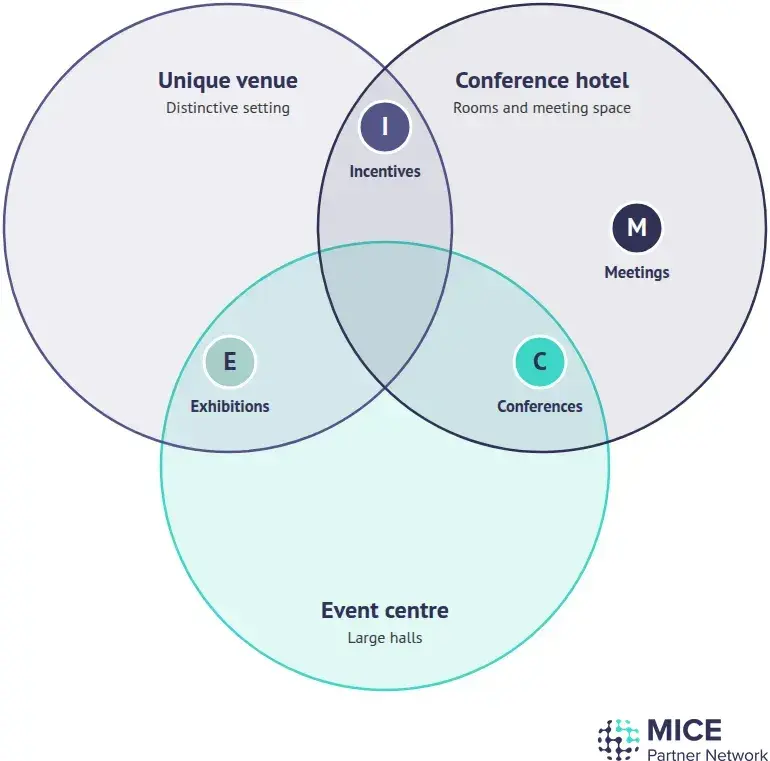 Where the four MICE formats typically take place, and where venue types overlap.
What challenges does MICE create for my hotel?
MICE creates challenges for a hotel because every enquiry is individual, has to be answered quickly and competes with offers from other properties. The demand exists, but turning it into bookings requires capacity, speed and a well-organised sales process.
Every enquiry is a competition
Companies rarely ask one hotel only. On the MICE Portal platform, companies sent each enquiry to seven hotels on average in 2025 and received 2.7 offers in return. Almost three of the hotels asked declined because they had no capacity available. A hotel that answers quickly and completely is therefore often one of only a few properties the planner seriously compares.
Enquiries are still handled by hand
Preparing a MICE offer means checking availability for rooms and space, combining packages, catering and technology and calculating a price. In a survey by the German Hotel Association IHA among 336 hotels in 2025, 79.2 percent said they still process enquiries manually. Only around 5 percent use automated software solutions, and a further 15.5 percent plan to introduce them.
Capacity has to fit
A conference needs meeting space and bedrooms on the same dates, and a meeting needs the right room size at the right time. When one of these pieces is missing, the hotel has to decline, even if everything else fits. Managing space and rooms together is one of the central tasks in MICE revenue management.
Corporate clients have requirements beyond the room
Companies increasingly expect information on sustainability, data protection and invoicing processes. According to the Meeting & EventBarometer, 60 percent of venues in Germany had a sustainability standard in place in 2025. Hotels without clear answers on these topics risk dropping out of procurement processes early.
Visibility in digital channels is uneven
Many companies search for and compare venues through MICE platforms. According to the IHA survey, 64 percent of the participating hotels are active on online MICE platforms, while 36 percent are not listed on any. Among all participating hotels, 56.9 percent said that less than 10 percent of their events came through MICE portals.
How do companies buy MICE events?
Companies buy MICE events through a mix of internal planners, agencies and digital platforms. In smaller organisations, assistants and team leads often organise meetings themselves. Larger companies increasingly manage meetings and events centrally, with procurement setting rules for approved venues, rates and processes, and planners sending enquiries through a platform or an agency.
Many larger companies now treat this as a discipline of its own, known as strategic MICE management. Procurement, travel management and event planners work with defined processes, approved suppliers and central reporting, so that spending, quality and compliance can be steered across the whole organisation. For hotels, this means enquiries increasingly arrive through structured processes, with clear requirements and a defined decision path.
For hotels, this means the decision is often made by someone who compares several offers side by side, follows internal guidelines and needs a reliable answer within a short time. On the MICE Portal platform, 84 percent of the enquiries placed in 2025 were booked, and around a third of the offers hotels submitted led to a booking, as MICE Portal reported in March 2026. Enquiries that arrive through a procurement platform therefore usually lead to an actual event.
Which MICE formats can my hotel serve?
The MICE formats a hotel can serve depend on its meeting space, bedroom capacity, location and team. A property with two or three meeting rooms and a small team is well placed for meetings, seminars and trainings. A property with a large plenary room, several breakout rooms and a sizeable room block can compete for conferences. A property with a distinctive location or setting is attractive for incentives and evening events.
Being clear about this fit pays off in sales. A hotel that answers the enquiries it can serve well, and quickly declines the ones it cannot, wins a higher share of the offers it submits.

Photo: Adobe Stock
Which trends are shaping the MICE market?
The MICE market is shaped by a continued return to in-person events, growing international demand, sustainability requirements and the digitalisation of procurement and sales. The figures in this section come from the Meeting & EventBarometer 2025/2026 for Germany, from the Events Industry Council for the global market and from the IHA survey for hotels.
In Germany, participant numbers at in-person events rose again in 2025. Worldwide, the Events Industry Council expects direct spending on business events to reach 1.6 trillion US dollars by 2028.
International demand is growing, with 10.7 percent of participants and 11.7 percent of organisers in Germany coming from abroad in 2025. For hotels, this means offers, websites and profiles on platforms increasingly need to work in more than one language.
Sustainability has become part of the standard requirements, and 60 percent of venues in Germany already work with a sustainability standard. Technology is entering the industry gradually, with 12 percent of venues saying they already use general AI applications. On the hotel side, the IHA survey shows how much room there still is for automating enquiry handling, since 79.2 percent of the participating hotels still process enquiries manually.
Frequently asked questions
How do I reach the companies that book MICE events?
Hotels reach companies that book MICE events through direct sales, agencies and MICE platforms on which corporate clients search for venues and send their enquiries. The MICE Partner Network connects hotels and venues with companies that manage their meetings and events through MICE Portal and OneMICE. Registration is free for suppliers, and enquiries arrive from corporate clients across Europe.

Sources
Conference & Meetings World, USA and Lisbon top the 2025 ICCA GlobeWatch rankings, May 2026
Eurostat, Tourism statistics, characteristics of tourism trips, data extracted October 2025
Events Industry Council and Oxford Economics, 2026 Global Economic Significance of Business Events, Executive Summary, May 2026
Events Industry Council, EIC Releases Full 2026 Global Economic Significance of Business Events Study, August 2026
German Convention Bureau, EVVC and German National Tourist Board, Meeting & EventBarometer Germany 2025/2026, results presentation, May 2026
Hotelverband Deutschland (IHA), survey on the relevance and use of MICE portals in Germany, press release, 16 June 2025
International Congress and Convention Association (ICCA), GlobeWatch Country and City Rankings 2025, press release, May 2026
MICE Portal data, March 2026
UFI, Euro Fair Statistics 2024, press release, October 2025