

Contents
Hotels choose the right MICE booking platform by checking where its corporate demand comes from, what the listing costs and when, and how well it fits the daily work of the sales team. A MICE booking platform is a digital system on which companies and their planners find, request and book hotels, venues and event services for meetings, incentives, conferences and events.
This guide explains what MICE booking platforms are, why they are worth using for a hotel, how to recognise a reputable one and which questions to ask before you list your property. It closes with how the MICE Partner Network fits in and how your property gets started.

Photo: Adobe Stock
What is a MICE booking platform, and how does it work for my hotel?
A MICE booking platform is a digital channel through which corporate planners search for venues, send RFPs and book offers for meetings, incentives, conferences or conventions, and exhibitions or events. For a hotel or venue it works as an additional sales channel that brings requests to the property without cold acquisition. Our guide explains what MICE stands for.
Two types of platform are common. Procurement platforms are the systems companies use to buy their events. Each company purchases through its own company shop with its own approval rules and purchasing terms, and the RFPs your property receives come from inside that shop. Venue finders are brokerage platforms that connect planners with properties. Vinzenz von Brühl describes the core difference in his series on MICE procurement. On a procurement platform the company is the customer, while a venue finder’s client is the property. Both types can bring business to your hotel, and our guide to the MICE Partner Network compares the two side by side.
Why should my hotel use a MICE booking platform?
A MICE booking platform puts your hotel where corporate planners already search for venues, so RFPs reach your property from companies your sales team has not contacted yet. Larger companies increasingly buy meetings and events through procurement processes with approved suppliers, purchasing terms and a defined approval path. A property that is listed on the platforms behind those processes is part of the selection from the start.
The requests that arrive this way belong to events that companies plan to hold. On the MICE Portal platform, 84 percent of the RFPs placed in 2025 were booked, and around a third of the offers hotels submitted led to a booking. Each MICE RFP arrives with dates, participant numbers, services and the client’s terms already defined, which makes the offer faster to prepare and easier to compare.
Personal relationships remain at the heart of hotel sales. A platform adds reach and speed, and the contact details of the person who needs the event come with the request, so your team builds the relationship from the first offer onwards. Bookings from clients your team already works with can run through the same channel, which keeps your property bookable for companies that buy through a platform.

Photo: Adobe Stock
How do I recognise a reputable MICE booking platform?
A reputable MICE booking platform is open about who sends the RFPs, what the listing costs and how results are ordered, and it puts these answers in writing before you sign. These signals help your team tell a strong partner from a listing that is hard to assess.
The platform can name its demand. It states how many corporate clients and active planners use it, in which countries and industries they work, and what share of requests and offers leads to a booking. A platform with a real demand side has these figures at hand.
Its costs are clear in advance. Fees, commission and the point at which they arise are stated in writing, and where a commission applies, it is visible before your team submits an offer. The rules for bookings from your existing corporate clients are equally clear.
Placement is explained. The platform tells you which profile data counts for visibility, which paid options exist and whether planners can see when a placement has been paid for.
The process is binding for both sides. Requests carry the client’s purchasing terms and an option date, deviating conditions have a defined place in the offer, and the contract follows digitally after the booking.
Support is personal. A reputable platform gives your team a named contact, helps with the profile during onboarding and explains how offers work. Together, these signals show that a platform is built for long-term business with hotels.
Which questions should I ask before listing my hotel on a MICE platform?
Before listing your hotel on a MICE platform, ask six questions in three areas, the platform and its demand, its costs and visibility, and the daily work with RFPs and the profile. Ask them in a demo and ask for the answers in writing, so your team can compare platforms on the same basis.
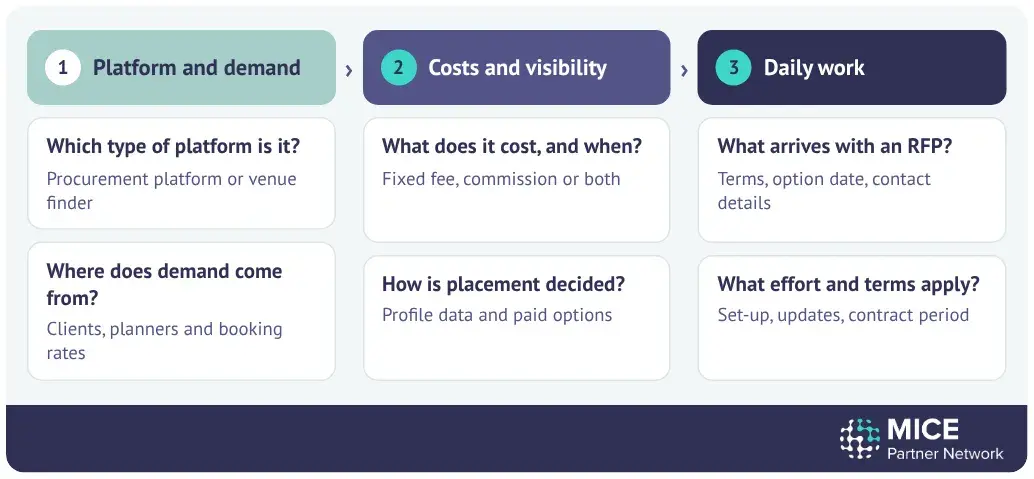
Six questions in three phases that help hotels choose the right MICE booking platform.
Which type of platform is it, and where does my demand come from?
The first question is which type of platform you are talking to, because it decides where the RFPs come from and which terms come with them. The second is where the demand comes from. The number of listed hotels describes the supply side and tells you how many properties appear alongside yours. The demand side is what brings RFPs, so ask how many corporate clients buy through the platform, in which countries they are based, how many planners are active and whether agencies book on behalf of their clients. For a property that depends on corporate demand from particular markets, a strong client base in your source markets brings RFPs that fit.
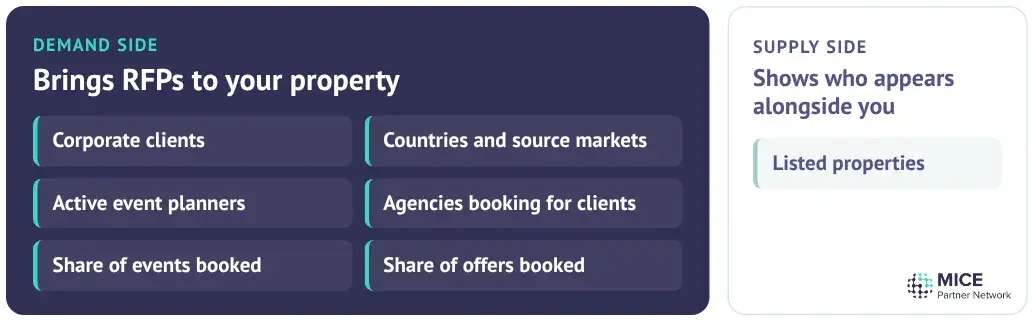
The figures that show how much demand a MICE booking platform brings your hotel.
What will the platform cost me, and how visible will my hotel be?
A MICE booking platform costs your hotel a fixed fee for the listing, a commission on bookings or a combination of both, and the point at which you pay matters as much as the amount. The common cost models compare as follows.
Ask whether commission can differ by client or booking channel, and whether it applies when a client with a framework agreement books your property through the platform. For visibility, ask which factors decide the placement of your property and whether the system shows you where your profile stands.
How does the platform fit my team’s daily work?
A well-structured MICE RFP reaches your hotel with dates, participant numbers, services, an option date and the client’s purchasing terms. Ask how your team submits an offer, where deviating conditions go and how the contract is concluded after booking. When offers can be sent straight from the request email, every RFP fits into the daily routine of a busy sales office.
The profile needs one focused set-up phase with master data, photos, meeting rooms, capacities, catering, technical equipment and the email addresses that receive requests, followed by regular updates whenever the property changes. Ask whether the system shows which fields are still missing, whether one account can manage several properties and which contract period and notice period apply.
Can I list my hotel on more than one MICE platform?
Yes, a hotel can be listed on several MICE booking platforms at the same time, and many hotels are. Germany shows the pattern at country level. In a survey by the German Hotel Association IHA among 336 hotels, published in June 2025, 64 percent of the hotels were active on at least one MICE platform, and the usage shares of the individual platforms add up to well over 100 percent.
The number of platforms your team can keep current is the natural limit. Every profile that stays up to date brings RFPs that fit, so the right number is the one your team can maintain well.
How does the MICE Partner Network connect my hotel to these platforms?
The MICE Partner Network is the shared supplier base behind the procurement platforms MICE Portal and OneMICE, so one profile in the network makes your property visible in the company shops of both. MICE Portal serves corporate clients in Germany, Austria, Switzerland and international markets and introduced the first digital purchasing solution for event services on the European market in 2004. OneMICE serves the French market.
The answers to the questions in this guide, summarised for the MICE Partner Network.
Placement in the network follows the data score, which shows how complete a profile is. New properties aim for at least 50 percent within the first 14 days, and marketing products such as Account Upgrades, Bidaro, Advertising Banners and Showcase Options add visibility on top. Our seven levers for more MICE RFPs show which details make the biggest difference once your listing is live.
Frequently asked questions
How do I get started?
Your property enters the MICE Partner Network in one of three ways. You register yourself, a corporate client invites you, or a planner adds your property to an RFP. Properties that are already listed simply request a login for their existing entry. Registration is free and has no contract period, and partner management supports your team personally from the first login. The supplier guides in our knowledge base walk you through login, profile and offers step by step.

Sources
MICE Portal data, March 2026
Hotelverband Deutschland (IHA), survey on the relevance and use of MICE portals in Germany, press release, 16 June 2025
Vinzenz von Brühl, MICE Procurement Part 2. The Enterprise Perspective, MICE Portal, September 2026
Want more enquiries for your hotel?
Our partner management team looks at your profile with you and shows how to improve your visibility in the network.